
Taking your medication, feeding your pet, watering a plant, drinking a glass of water: these everyday tasks are essential, yet all too often overlooked in our daily routine. In this guide, you'll find simple, effective methods to stop forgetting the small habits that make all the difference.
Key takeaways:
- Treat your routine as a single system.
- Tie each task to a fixed moment in your day.
- Habits take time to form, so be patient.
- One missed day doesn't mean you've failed.
Why we forget the little everyday care tasks
We forget the little care tasks because they're short, repetitive and silent. Nothing tells you it's time, so it all comes down to your memory, which is already stretched thin by everything else (work, studies...).
Just another day
You get up, jump in the shower, gulp down a coffee standing up. The morning pill is waiting in the bathroom drawer, but you're already hunting for your keys. The cat meows in front of an empty bowl. You fill it, wondering whether you already did last night, or was it the night before? In the evening, walking past the shelf, you notice the plant's leaves are drooping. Once again, the watering slipped through the cracks. None of these lapses is serious on its own. Added together, they leave you feeling like you're always chasing after your own home.
Why memory isn't enough
- No natural signal: hunger reminds you to eat, tiredness to sleep. A pill, a plant or a food bowl sends you no signal until it's too late.
- Actions too quick to stick: a ten-second action repeated every day leaves almost no memory behind. Hence the familiar doubt: "Did I take it or not?"
- A routine that shifts: a later wake-up, a weekend, a trip, and the usual sequence falls apart. The care task tied to that moment goes with it.
- A mental load that's already full: when your mind is juggling work, groceries and appointments, small tasks with no deadline come last.
So the problem isn't a lack of willpower. It's the lack of a trigger.
In short
For a daily routine to stick, it needs three things:
- A signal that alerts you, instead of relying on memory.
- A fixed moment, anchored to something you already do.
- A visible spot, where the item you need is right in front of you.
How to build a daily care routine that sticks
A care routine sticks when every task has a fixed place in your day and is tied to something you already do. The rest is method: list everything, group it, then start small.
1. List everything, then group by time of day
Take five minutes and write down every small care task you're responsible for: your morning pill, the cat's food bowl, watering the ficus, hand cream, stretches.
Then sort each task into a time slot:
- Morning: things you do when you wake up or at breakfast.
- Midday: things that go with lunch or your break.
- Evening: things you do when you get home or before bed.
- Weekly: things that don't come up every day, like some watering.
This turns a vague list into three or four small blocks that are easy to picture.
2. Tie each task to an existing habit
Your brain remembers a new task more easily when it follows something you do on autopilot. Frame it like this: "After X, I do Y."
- Morning coffee: take your vitamin while the coffee brews.
- Brushing your teeth: apply your skincare right after.
- Getting home from work: put down your keys, then refill the dog's water.
The trigger is already there. All you have to do is add the task.
3. Start with two or three tasks, not ten
Trying to start everything at once is the surest way to give it all up. Pick the two or three most important tasks, and only add another once the first ones happen without thinking.
How to Stop Forgetting Your Medications and Vitamins
To stop forgetting your medications, tie them to a specific time of day and to a signal that reminds you. Good intentions alone aren't enough, especially on busy days.
What helps without any technology
- A set time: the same time every day, ideally anchored to a stable moment like breakfast or bedtime.
- Storage next to a daily habit: keep the box beside the coffee maker or your toothbrush. The habitual action becomes your trigger.
- A checklist calendar: mark an X after each dose. Whenever you're unsure, a quick glance tells you whether you've taken it, so you avoid taking a double dose.
Why an active signal makes the difference
A pill organizer or a well-placed box is still a passive reminder. It only works if you walk past it at the right moment and your attention is free.
On the morning you're running late, the box stays on the counter and nothing reminds you. An active signal, like an alarm or a notification, comes to you at the set time, even when your routine goes off the rails.
If you miss a dose, don't decide on your own
Never change a treatment on your own: don't double up on a missed dose, and don't stop a medication without advice. If you're unsure or have missed a dose, ask your doctor or pharmacist, who knows your treatment.
The same logic applies to vitamins: a set time, a visible trigger, and a signal that reminds you. Keep a calendar near your medications and check it off right after each dose. You'll always know whether you've taken it, without having to rely on your memory.
Pet Care Routine
A pet care routine sticks when you separate two things: the daily tasks, which are easy to anchor to your schedule, and the occasional care, which gets forgotten precisely because it doesn't come up often. The first needs a fixed cue, the second a date.
Daily care
These are the tasks your pet often asks you for on its own. They're easier to keep up if they're tied to a specific moment in your day.
- Meals: serve them at regular times, for example right before your own breakfast and dinner.
- Fresh water: replace it instead of just topping it up, especially when it's hot.
- Walks: for a dog, fit them around moments you never skip, like waking up or getting home from work.
- Play: a few minutes a day makes a difference, even on busy evenings.
The occasional care that slips through the cracks
The trap is thinking "I did that recently, I think." One week goes by, then three.
- Brushing: how often depends on the coat and the shedding season.
- Litter box: a full clean comes on top of daily scooping and is easy to put off.
- Prescribed treatments: flea and tick treatments, dewormers or medications follow the schedule set by your vet. Write down the date of the next dose as soon as you give one.
Sharing tasks across the household
With several people, there's a double risk: the cat gets fed twice, or nobody walks the dog because everyone assumes someone else did. Assign each task to a single person, with a clear name and time.
A chart on the fridge where you check off what's done is often enough. What matters is that everyone can see at a glance without having to ask.
Ask your vet
Every animal has its own needs depending on its species, breed, age and health. At your next visit, ask your vet what frequencies are right for yours: brushing, treatments, amount of food. If you notice anything unusual, they're also the one to see. As soon as you give an occasional treatment, write down the date of the next one right away. You'll never have to wonder when you last did it.
Watering Your Plants at the Right Pace
The right pace means watering regularly, deciding each time after checking the soil, not watering more heavily. Houseplants suffer from too much water far more often than from too little.
Too Much Water, or Water in Fits and Starts
According to University of Maryland Extension, overwatering is the leading cause of death in houseplants. The roots sit in soggy soil, run short of air, and eventually rot.
UConn Extension points to another trap: irregular watering, where the plant swings from dry soil to soggy soil, may be the main cause of its decline. You probably know the scenario: you forget the pot for ten days, notice the leaves dropping, and make up for it with a big glass of water.
The Finger Test
Before each watering, push a finger an inch or so into the soil.
- Dry deep down: water until it runs out of the drainage hole, then empty the saucer.
- Still damp: don't water, and check again in a few days.
- Soggy and smelly: let it dry out, and make sure the pot drains properly.
So your reminder isn't there to tell you "water." It's there to tell you "check." That's what keeps the pace steady without drowning the plant.
Adjusting to the Season and to Each Plant
- In summer: heat and light make plants drink more, so check more often.
- In winter: growth slows and the soil stays damp longer, so space out your checks.
- By species: a succulent can handle drying out completely, while a fern prefers slightly moist soil.
- By pot: terracotta dries out faster than plastic.
Group plants with similar needs together, so a single check covers the whole group. Set your reminder to "touch the soil" rather than "water." You stay consistent without ever watering on autopilot.
The self-care we keep putting off
Drinking water, stretching, resting your eyes, going to bed at a regular time: these habits come last because nothing demands them. A yellowing plant or a meowing cat gets your attention, but mild thirst or a stiff neck stays quiet until evening.
Why they slip to the bottom of the list
On a busy day, you deal first with whatever has a deadline: a meeting, an email, a child to pick up. Self-care has no cutoff time, so it always gets pushed back.
The result is all too familiar. You look up from your screen late in the afternoon, your water bottle still full, your shoulders in knots, and you end up going to bed later than planned.
Two-minute micro-routines
The trick is to make each habit tiny and tie it to a moment that already exists in your day:
- Drink water: a glass after every coffee break or each time you get back from a meeting. To go further, here's how to remember to drink water throughout the day.
- Stretch: two minutes on your feet as soon as a call ends, working your shoulders, neck and back.
- Rest your eyes: each time you finish a task, look into the distance, out the window if possible, for about twenty seconds.
- Go to bed at a regular time: choose a time to start your evening routine (screens down, lights dimmed), rather than a time to fall asleep, which you can't control.
If back pain, eye strain or trouble sleeping persists despite these habits, talk to a healthcare professional. Pair each habit with one specific moment in your day, such as "after coffee, a glass of water." A habit without a trigger almost always ends up forgotten.
The mistakes that make a care routine fail
A care routine rarely fails for lack of willpower. It fails because it relies on bad habits: too much trust in your memory, poorly designed reminders, and the urge to give up after the first slip.
Relying entirely on your memory
You know the dog needs its medication in the evening. But at 7 p.m., between dinner, a phone call and the dishes, it slips through the cracks.
Memory works well for things out of the ordinary. For repetitive, mundane tasks, it often confuses "I did it" with "I did it yesterday." An external cue does the job for you.
One generic reminder for ten tasks
An 8 a.m. alarm labeled "Care" tells you nothing useful. Medication, kibble, plants, sunscreen: you have to piece it all together in your head, and that's where forgetting creeps back in.
- One reminder per task: a specific message that tells you what to do.
- The right time for each task: the pill at breakfast, watering on Sunday, not everything at the same time.
Reminders that all sound the same
When every notification makes the same sound, your brain ends up filing them as noise. You swipe them away without reading them.
- Vary the sounds depending on the type of care.
- Write a clear message, for example "Vitamin D capsule, with coffee."
- Delete unnecessary reminders, so the ones that remain keep their weight.
Giving up after a missed day
You forgot to water the plants two days in a row and tell yourself the routine is ruined. That's the most costly mistake.
One missed day doesn't undo a habit. What matters is picking it back up the very next day, without trying to make up for it. To go further, see how to build lasting habits. After a missed dose, don't double up and don't redo everything at once. Simply resume the routine at the next scheduled reminder.
Schedule Recurring Reminders with Pushmi
With Pushmi, you can set up reminders that repeat on their own in seconds, organized by type of care. Your routine no longer has to live in your head.
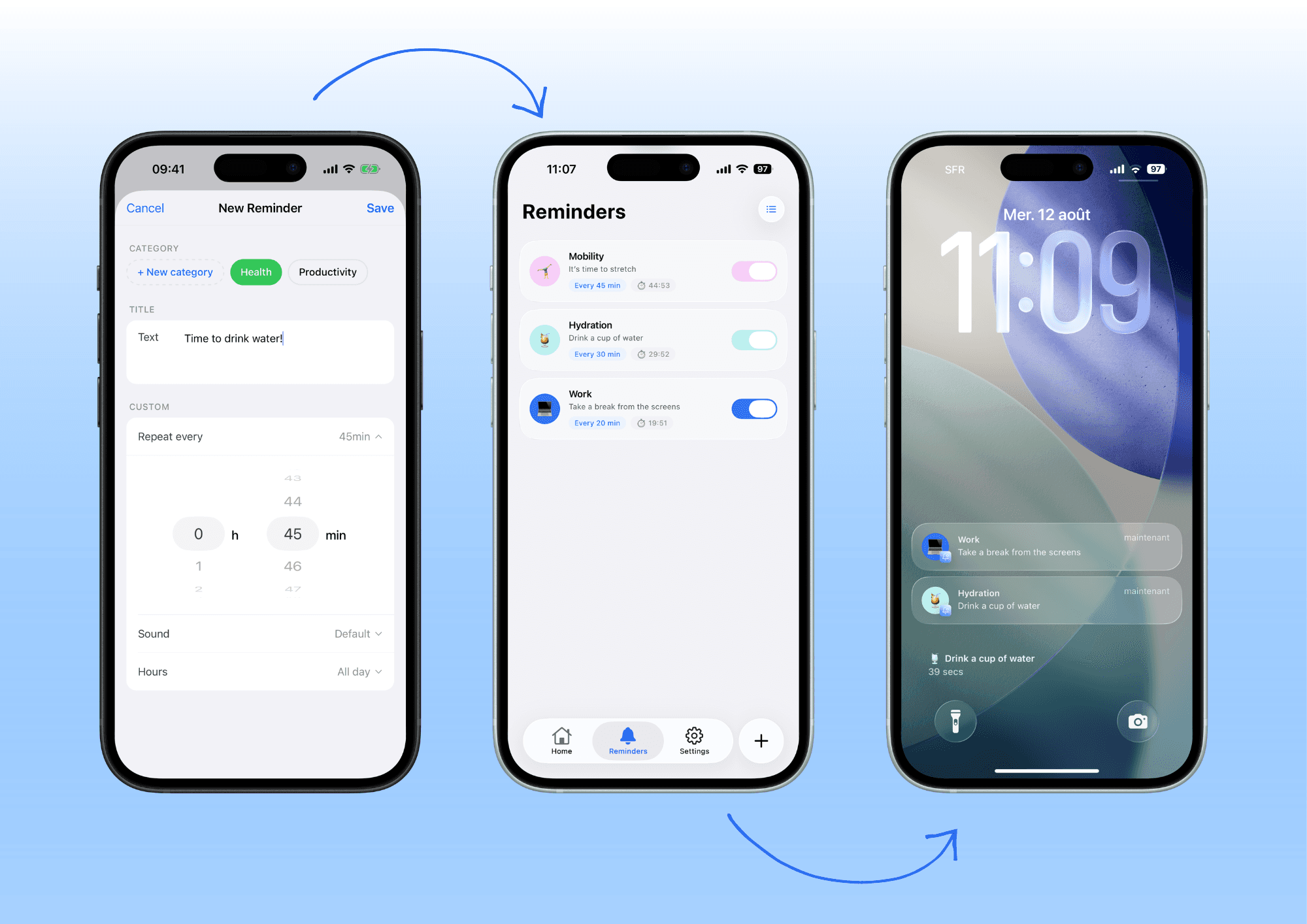
One category per type of care
Start by creating four groups, each with its own emoji:
- Health: medications, vitamins, appointments to prepare for.
- Pets: food bowl, fresh water, brushing.
- Plants: watering, checking the soil.
- Self-care: glass of water, stretches, screen break.
The emoji tells you right away what the notification is about, before you even read it.
Messages that tell you what to do
A reminder that says "remember the plants" gets swiped away. Write the exact action instead: "Touch the ficus soil, water if it's dry" or "Morning pill with breakfast."
The more specific the message, the less you have to think when it pops up.
The right rhythm for each task
Each reminder has its own interval: every hour for water, several times a day for the cat's bowl. You can run multiple reminders at once without them getting mixed up.
Assign a different sound to each category. Just by listening, you'll know whether it's the dog or your medication calling.
See everything at a glance
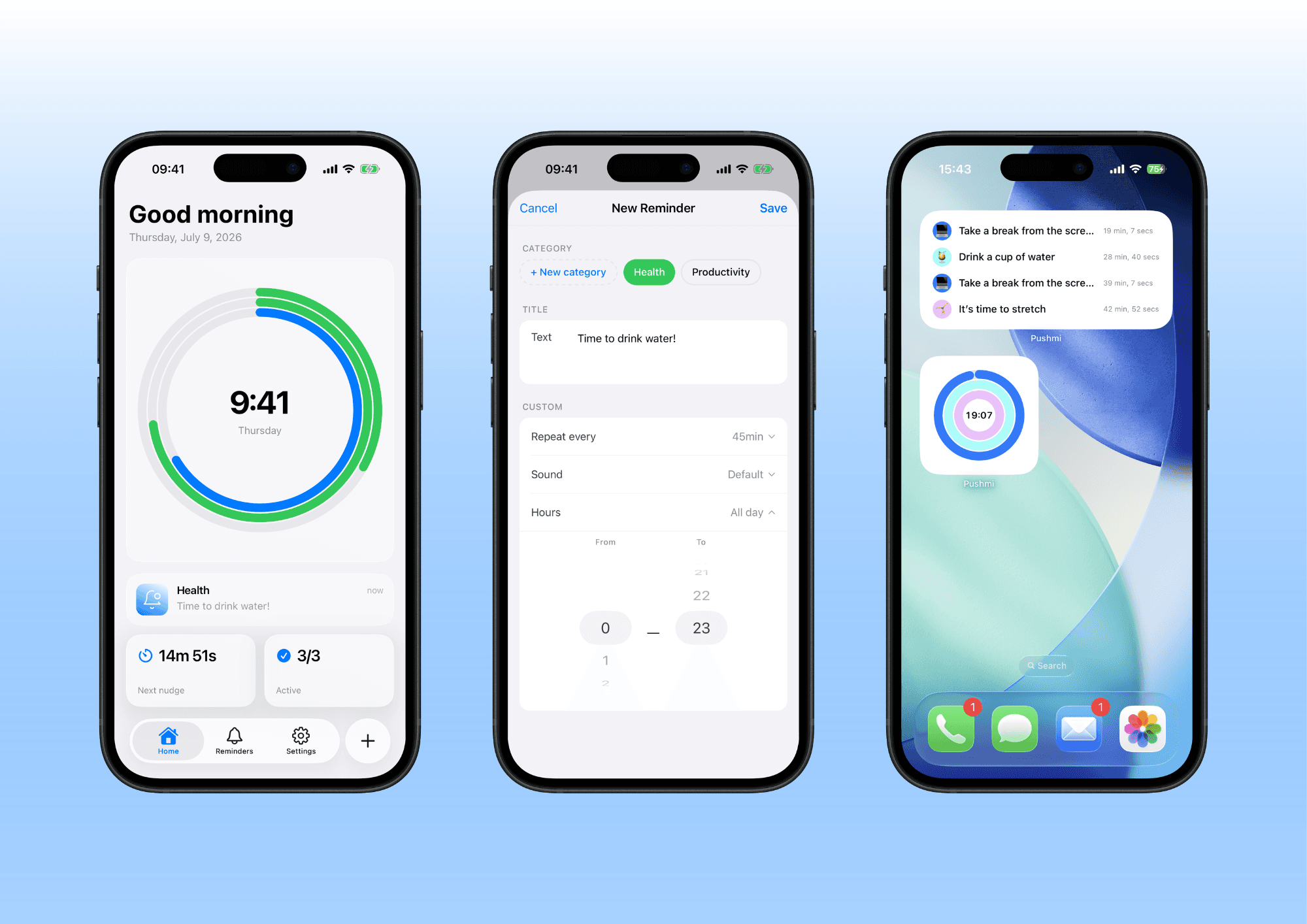
Widgets on both the Lock Screen and Home Screen show your active reminders. In the app, each running reminder has a ring that empties until it next goes off, so you can see how your day is going without opening anything.
And none of it ever leaves your phone: Pushmi collects no data and doesn't track you. If you'd like to compare a few tools first, check out our comparison of iPhone reminder apps. Start each reminder with the action to take ("take," "water," "fill"). You'll act right away instead of putting it off.
A simple plan to get started this week
To get going, you need three tasks, three reminders, and a check-in at the end of the week. That's it: a routine that starts small is more likely to last.
Day 1: Make a list and pick three tasks
- Write everything down: medications, vitamins, feeding and walking the dog, watering the plants, skin cream, stretches. List everything that sometimes slips your mind.
- Narrow it down: keep the three tasks that cost you the most when you forget them, whether for your health, your pet, or your plants.
- Set the rest aside: everything else on the list can wait until next week.
Days 2 to 6: One reminder per task, tied to a habit
- One task, one reminder: each task gets its own message, written in the words you want to read.
- An anchored moment: schedule the reminder right after something you already do. Your pill after your morning coffee, the dog's bowl when you get home from work, watering the plants on Sunday after breakfast.
- The right rhythm: daily for a medication, less often for a plant. The interval follows the need, not the other way around.
If you'd rather start without an app, your phone's built-in tools are enough. This guide explains how to set up an hourly reminder on iPhone.
Day 7: Adjust before you add
Look at which reminders went off at the wrong time and move them. Only add a fourth task once the first three stick without effort.
Don't get discouraged if you missed a day. One missed day doesn't undo a habit, and a habit often takes weeks to become automatic. So a single week just lays the groundwork.
Take action
If you want to group these three reminders by category, with a sound you'll actually notice, download Pushmi for free on the App Store. Start with three reminders at most. Only add a new task once the first ones happen almost without thinking.
Your next step
If you remember only one thing, make it this: a care routine sticks because you're reminded at the right moment, not because you have a good memory. With Pushmi, you can organize medications, pets, plants, and self-care into categories, each with its own recurring reminders and custom message. Your routine comes to you, without adding to your mental load.
Frequently Asked Questions
What's the best way to remember to take your medication every day?
The most effective approach is to tie taking your medication to something you already do every day, like your morning coffee or brushing your teeth. Keep the box somewhere you'll see it at that moment. For extra peace of mind, set a recurring reminder with a clear message. If you have any questions about timing or dosage, talk to your doctor or pharmacist.
Do I need a separate reminder for each care task?
Yes, one reminder per task usually works better, because a specific message tells you exactly what to do. To keep from getting lost, group them by category, such as Health, Pets, or Plants. That way, you can see at a glance what's coming up.
How often should you water your houseplants?
There's no one-size-fits-all watering schedule: it all depends on the plant, the season, the light, and the pot. For most plants, the simple rule is to water when the top of the soil feels dry to the touch. A regular reminder mainly helps you remember to check, and then you water only if needed.
How long does it take for a skincare routine to become automatic?
It often takes longer than people think. Expect several weeks, sometimes more, depending on the person and the habit. And missing a day here and there doesn't reset everything to zero.
How do you stop yourself from ignoring your reminders?
Keep only the reminders that truly matter, and write each one as a specific action rather than a single word. Pick a time and frequency that fit your day, and switch to a different sound if you've stopped noticing it. If you keep ignoring a reminder, that's a sign it needs changing, not that you need to add another one.