
A pill organizer alone isn't enough: in a French study published in BJGP Open in 2024, 61% of patients with chronic conditions said they forgot to take their medication, and using a pill organizer made no difference to how often they forgot. This 6-step guide is for you if you're on a treatment or take vitamins every day.
Key takeaways:
- Tie taking your medication to a habit you already have.
- Keep your medication where you'll see it.
- A pill organizer keeps things tidy; a reminder makes you remember.
- If you miss a dose, ask your doctor or pharmacist for advice.
Why We So Often Forget to Take Our Medication
We forget our medication because a daily dose becomes an automatic habit, and automatic habits are invisible. And you're far from alone in this.
According to the World Health Organization, people with chronic conditions in developed countries take their treatment as prescribed only about 50% of the time (WHO, 2003).
A French study published in BJGP Open points the same way: 61% of the chronically ill patients surveyed said they forget their medication. Notably, using a pill organizer made no difference to how often they forgot (BJGP Open, 2024).
A scene you probably know well
Your alarm goes off late. You gulp down a coffee standing up, hunt for your keys, and rush out the door.
Your pill box, meanwhile, is still sitting in the bathroom cabinet with the door closed.
That evening, as you're brushing your teeth, a question pops up: "Did I take it this morning?" You can't remember for sure.
What's going on in your head
When you repeat an action every day, your brain files it away as an automatic habit. That's handy for driving or tying your shoes, but much less so for taking medication.
Two things then happen:
- You stop noticing the action: it happens without attention, so it leaves almost no memory behind.
- Nothing reminds you: without an external cue, like an object in plain sight or an alert, a missed dose goes unnoticed until evening.
So the problem isn't a lack of willpower. It's a lack of a trigger. The steps that follow are designed to create one.
Step 1: Pair your dose with something you already do
The easiest way to stop forgetting is to link your medication to something you already do every day without thinking. That habit becomes the trigger, and taking your dose follows naturally.
Pick a fixed habit
Choose a moment in your day that happens at the same time, no matter what. The more automatic it is, the better it works.
- Your morning coffee: you make it every day, often at the same time.
- Brushing your teeth: a habit repeated morning and night, ideal for a medication taken twice a day.
- Dinner: a reliable cue if your medication should be taken with food.
Avoid moments that change from day to day, like a workout or a commute that only happens on weekdays.
Put the rule into words
Write your rule as one clear sentence: "After my coffee, I take my medication." This simple phrasing leaves no room for hesitation.
Say it out loud or write it down somewhere for the first few days. With repetition, your coffee will cue your dose, effortlessly.
Check the timing with a professional
Some medications are taken on an empty stomach, others with a meal, and others need to be spaced apart from another treatment. The habit you choose has to fit these instructions.
Before setting your rule, ask your doctor or pharmacist whether that moment works. They can also tell you what to do if you miss a dose, since the answer depends on each medication.
Step 2: Keep your medication where you'll see it
Put your medication right where you do your anchor action, in plain sight. A box tucked away at the back of a drawer won't remind you of anything, but one sitting in your path will prompt you to take your dose.
Choosing the right spot
If you take your pill after your morning coffee, keep it next to the coffee maker. If you take it when you brush your teeth, a spot near the sink might seem like the obvious choice.
Before you decide, read the patient leaflet. It often explains how the medication should be stored: away from heat, light or moisture, and sometimes in the fridge. A bathroom, which gets warm and humid after a shower, isn't always suitable.
- Kitchen: handy for doses taken with meals, as long as you avoid the top of the oven or a sunny windowsill.
- Bedside table: useful for a dose at bedtime or when you wake up.
- Hallway: a good fit if your anchor action is picking up your keys.
If you're not sure how to store something, your pharmacist can tell you where to keep each medication.
Think about children
"In sight" should never mean "within reach" of a child. If children live with you or visit often, keep your medication up high, in a locked cupboard or in a box they can't open.
You can then leave a visible cue where you do your anchor action, such as a small note or the day's empty box, while keeping the pills out of reach.
Keep a small supply with you
Missed doses often happen when you're away from home: a day that runs late, an unplanned dinner, a night somewhere else. A small supply in your bag or toiletry kit helps you avoid skipping a dose.
Keep these pills in their original packaging, with the leaflet if possible, and remember to restock your supply whenever you use it. If you need to store your medication up high, leave a visible cue where you do your anchor action so you still get the reminder without putting children at risk.
Step 3: Use a pill organizer, but not on its own
A pill organizer is useful, as long as you don't expect it to do something it can't. It helps you see where you stand, but it won't remind you when it's time to take your medication.
What a pill organizer does well
Its real strength is visual tracking. An empty compartment means a dose taken. A full compartment means a dose still waiting.
That way, you avoid the classic evening doubt: "Did I take it this morning?" A quick glance is enough, with no need to count the pills in the box.
It also saves you time. You prepare the whole week in one go, and each dose comes down to opening a compartment.
What it doesn't do
A pill organizer stores your pills, but it doesn't make you think to take them. If it stays shut in a drawer, the day's compartment stays full and nothing alerts you.
A French study showed this: 61% of the patients with chronic conditions who were surveyed said they forgot their medication, and using a pill organizer didn't change how often they forgot (BJGP Open, 2024). It's a good tool, but it isn't enough on its own.
How to make it truly effective
- An anchor habit: open the compartment right after something you already do every day, like your morning coffee or brushing your teeth. This technique is explained in detail in how to build lasting habits.
- A visible spot: keep the pill organizer where that habit happens, not in the bathroom cabinet if your anchor is in the kitchen.
- A cue: add a trigger that comes to you at the scheduled time, for the days when your anchor habit slips.
- A regular refill: always fill it on the same day of the week. If you're unsure how to fill the compartments, ask your pharmacist for advice. Fill your pill organizer on the same day each week, and check the day's compartment before going to bed: if it's still full, you'll spot the missed dose right away.
Step 4: Set a reminder for your medication
A scheduled reminder gives you what a pill organizer can't: a prompt from outside, at exactly the right time. You no longer have to remember; your phone does the remembering for you.
But the reminder still needs to be clear, and it shouldn't get lost among all your other notifications.
A message that tells you exactly what to do
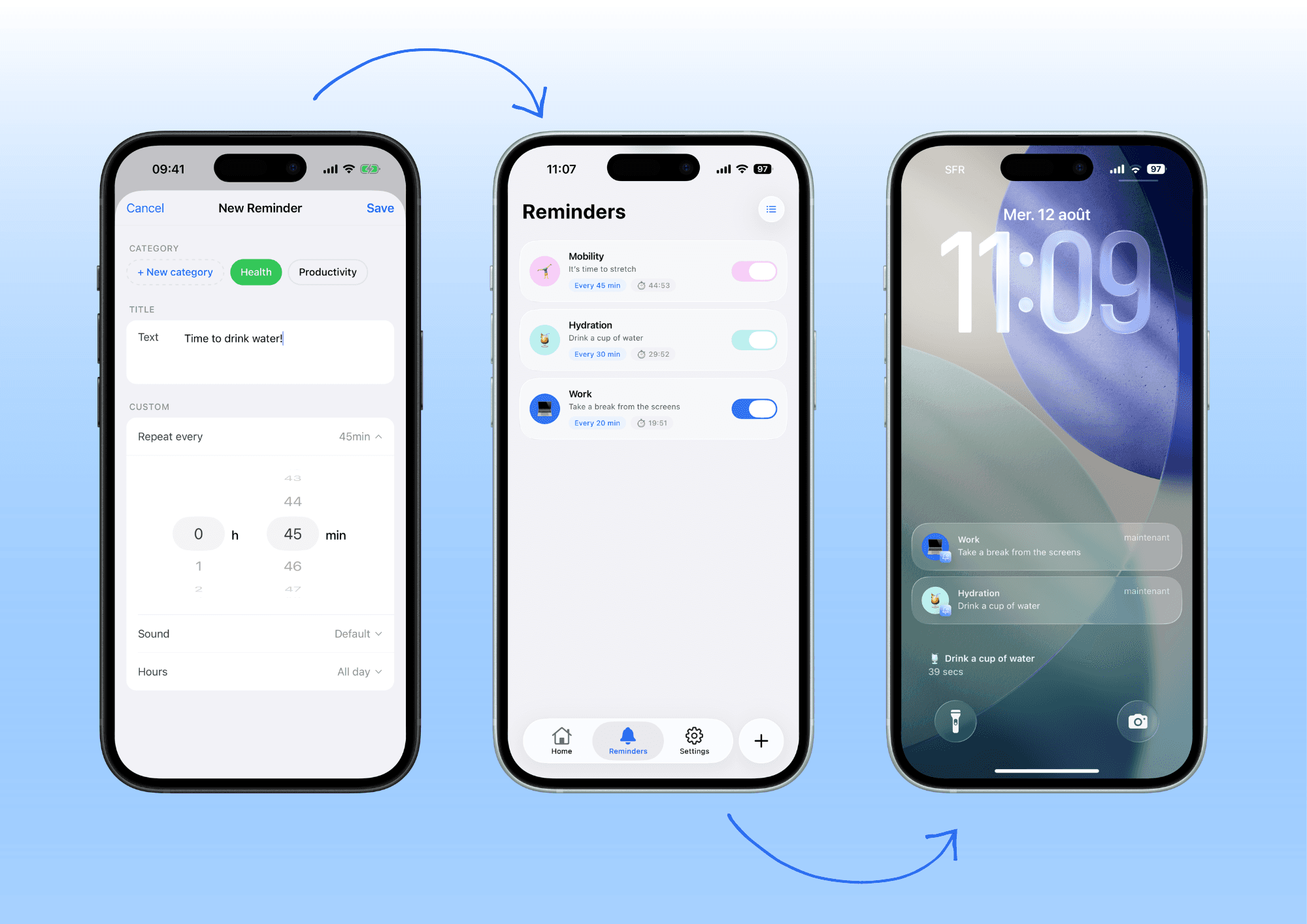
With Pushmi, you write the notification text yourself. Instead of a vague "Medication," try something like "Morning pill, with a glass of water."
File this reminder under a Health category with its own emoji. You'll spot it instantly, even if you have other reminders for work or home.
A reminder you recognize without looking
- A distinct sound: pick a sound that's different from your messages and emails. Over time, you'll know it's time for your medication before you even unlock your phone.
- A lock screen widget: your active reminders stay visible at a glance every time you turn on your screen.
Multiple doses a day
Some medications need to be taken two or three times a day. You can run several reminders at once and set the interval for each one, based on what your doctor prescribed.
How often you take your medication is still a medical decision: the reminder follows your prescription, it doesn't replace it. For step-by-step setup, see how to set up a recurring reminder on iPhone. In the reminder text, include the medication and how to take it ("with a glass of water," "with a meal"). That way, you can act right away without having to think.
Step 5: Make sure you actually took your dose
To know whether you've taken your medication, don't rely on memory: write it down right after you take it. A two-second habit saves you from that evening doubt when you can't remember whether you took your morning pill.
Check it off right away, not later
The best time to record it is the second after you take it, before you even put the box down. If you wait, the memory gets mixed up with yesterday's.
- A paper calendar: stuck on the fridge or near your medications, you cross off the day's box.
- A note on your phone: one line per day, with the time if your treatment involves several doses.
- The box itself: some people write the date on the packaging with a marker when they open it.
The method doesn't matter much. What matters is always recording it in the same place, so you only have one place to check.
Don't take another dose "just in case"
Doubt sometimes tempts you to take another pill to be safe. That's exactly the risk to avoid: a double dose can cause problems, depending on the medication.
If you can't remember, check your calendar or note first. If there's no written record, don't take anything on your own.
If you miss a dose
What should you do if you realize you've missed a dose? The answer depends on the medication: with some you can catch up, with others you can't.
- Read the leaflet: it usually explains what to do if you miss a dose.
- Ask your pharmacist or doctor if the leaflet doesn't cover your situation.
- Never double the next dose to make up for it, unless a healthcare professional has told you to.
Ask your pharmacist once about each of your medications, and write down the answer. That way, you'll have the instructions on hand the day you miss a dose. Check off your calendar or note before you even close the box. On the day you're unsure, you just have to check instead of guessing.
Step 6: Plan for the days that break your routine
Missed doses happen most when your day takes a different shape. The fix: keep the same anchor habit, even when the time or place changes, and plan ahead for anything that could leave you without your medication.
Weekends and lie-ins
On Saturdays, the alarm goes off later and breakfast sometimes gets skipped. If you take your medication with your morning coffee, it's the coffee that matters, not the clock.
So stick with the habit, even if it happens later. If your treatment needs to be taken at a specific time, ask your doctor or pharmacist how much leeway you have.
Travel and jet lag
When you're away, your usual cues disappear: no kitchen, no familiar bedside table. Recreate them as soon as you arrive.
- Carry-on bag: keep your medication with you, never in your checked luggage.
- Same spot: put it next to your toothbrush at the hotel, just like at home.
- Time zone changes: before you leave, ask your pharmacist how to adjust your dosing times.
Prescription refills
An empty box on a Sunday evening is a guaranteed missed dose. Note the date when you'll have about a week of medication left, and book an appointment or stop by the pharmacy then.
That buffer also protects you if the pharmacy runs out of stock or your doctor isn't available.
These adjustments stick better when they're part of a consistent whole. To go further, find out how to build a daily routine so you never forget anything.
The day before a trip, count your pills and make sure you have enough for your entire stay, plus a few extra days.
Mistakes That Make You Forget Your Medication
Most missed doses aren't about a lack of willpower. They come from a few habits that quietly weaken your routine without you noticing.
Relying on memory alone
You tell yourself you'll remember because it matters. But memory tends to fail on exactly the busy days, when your attention is elsewhere.
Your treatment shouldn't depend on how tired you are. Hand the job of remembering to an external cue: a set routine, a box in plain sight, a reminder.
Changing the time from one day to the next
Morning one day, noon the next, evening the day after: your brain has no fixed moment to link with taking your medication. The habit never takes hold.
Pick a consistent time and stick to it as much as you can. To go further, see how to build lasting habits.
Keeping the boxes at the back of a cupboard
Out of sight, out of mind. A box tucked behind the others won't remind you of anything.
Keep your medication where you'll be at the right time, while following the storage instructions on the leaflet.
Dismissing a reminder with "in five minutes"
The notification goes off, you close it, and you plan to come back to it. Five minutes later, you've moved on and the dose is forgotten.
When the reminder comes, take your medication right away, or put the box in front of you so you can't ignore it.
Stopping or changing your treatment without talking to a professional
You feel better, so you skip a dose, or you take a double dose after missing one. These decisions can have consequences you may not realize.
For any questions about a missed dose, stopping treatment, or changing your dosage, ask your doctor or pharmacist. When the reminder goes off, take your medication immediately instead of putting it off. A postponed reminder is often a lost one.
How Pushmi helps you build the habit
Pushmi reminds you to take your medication at the time you choose, with the message you wrote. You can also see where your routine stands at a glance, without having to think about it.
Rings to visualize your routine
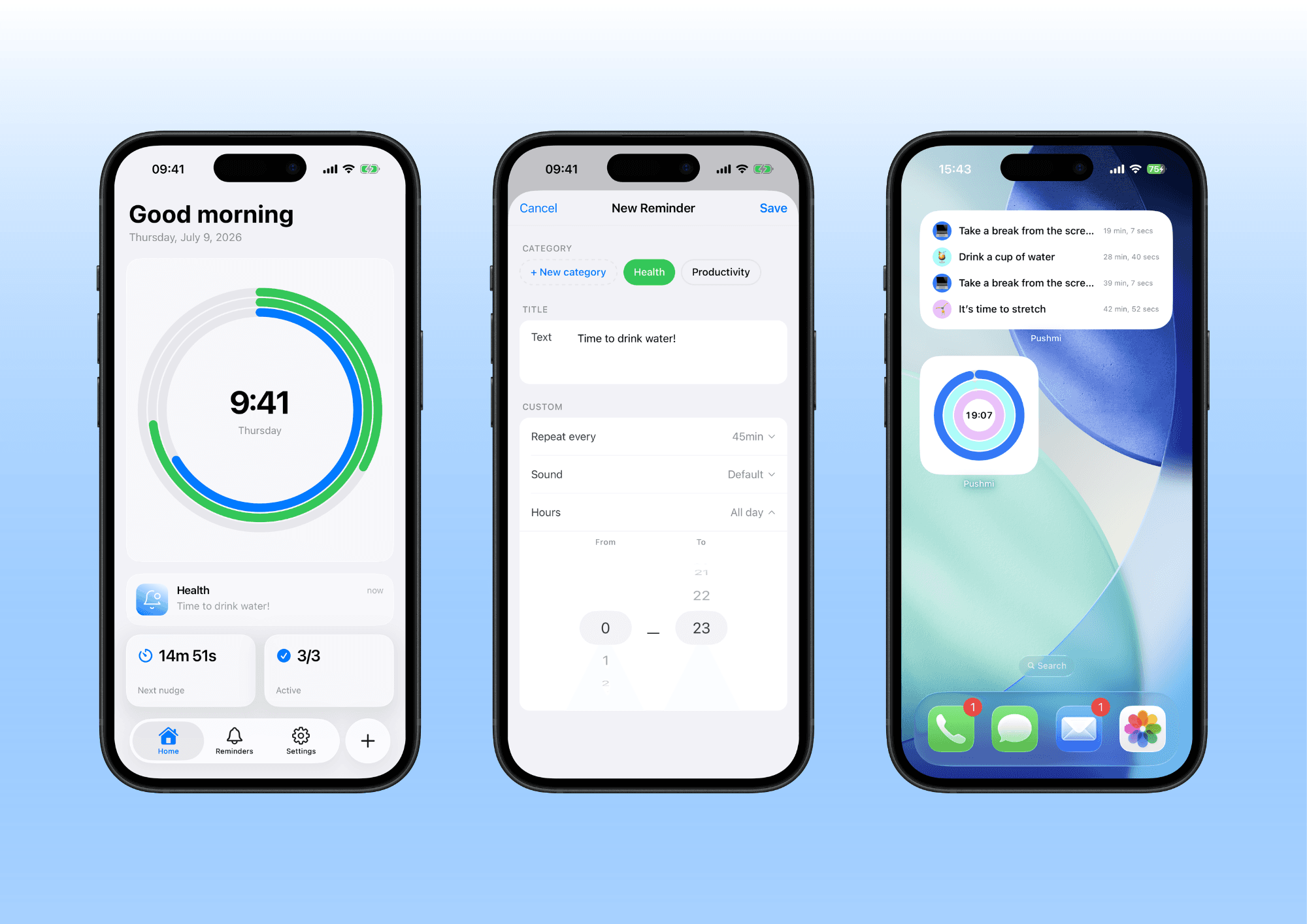
On the home screen, each active reminder has its own ring. The ring shrinks as the time of the next reminder approaches.
So you know right away which reminder is about to go off. Widgets show the same view on the lock screen, without opening the app.
A reminder ready in seconds
Creating a reminder takes just a few taps:
- The message: write the exact words you want to read, for example "Evening pill, with dinner."
- The interval: choose how often the reminder repeats.
- The sound: pick a different tone for your medications so you can recognize it without looking.
The interface stays clean, with nothing to distract you from what matters.
Your health data stays with you
Pushmi collects no data and does no tracking. What you note about your treatments never leaves your phone to feed some database.
That matters when your reminders are about your health.
One tool for your whole routine
Several reminders can run at the same time. You can sort them into categories, each with its own emoji: a "Health" category for your medications and vitamins, another for water, another for work.
The method stays the same from one habit to the next. It works just as well, for example, to remember to drink water.
Your next step
If you remember just one thing, make it this: a pill organizer keeps your tablets in order, but what actually gets you to take them is a reminder at the right moment. With Pushmi, you write your own reminder message and choose how often it repeats and which sound goes with it, so taking your medication no longer depends on your memory.
Frequently Asked Questions
What should I do if I forgot to take my medication?
Don't take a double dose to make up for a missed one unless your doctor has told you to. What you should do depends on the medication and how much time has passed, so check the leaflet or call your pharmacist or doctor. Afterwards, make a note of when you missed the dose so you can plan ahead next time.
What's the best time of day to take your medication?
The right time is first and foremost the one your doctor or pharmacist has recommended, since some medications should be taken on an empty stomach, others with a meal or in the evening. If you have a choice, take them at a moment you never skip, such as breakfast or brushing your teeth. A set time tied to an everyday habit is much harder to forget.
How to remember to take your vitamins every day?
Tie taking your vitamins to something you already do every day, and keep the bottle where you'll see it at that moment, next to the coffee maker, for example. If that isn't enough, set a reminder on your phone with a clear message for the time you usually do it. It's also worth asking a pharmacist whether your vitamins should be taken with a meal.
Is a Pill Organizer Enough to Stop Forgetting Your Medication?
No, not on its own. In a French study (BJGP Open, 2024), 61% of patients with chronic conditions said they forgot to take their medication, and using a pill organizer made no difference to how often they forgot. It keeps your pills organized and lets you check whether you've taken a dose, but it won't remind you to take it, so pair it with a fixed daily routine or a reminder.
How can you help an elderly loved one remember to take their medication?
The simplest approach is to tie each dose to a set moment in their day and keep the medication in plain sight at that spot. A pill organizer filled in advance then lets you check at a glance whether the dose has been taken, and an audible reminder can serve as a prompt. For any questions about the treatment or dosages, check with their doctor or pharmacist, who can also suggest a simplified dosing schedule.